Showing posts with label Writers and communicators - failing. Show all posts

Monday, February 08, 2010

Censorious old bag


The bullying of former England captain John Terry continued over the weekend.

One of the features of this episode has been the re-emergence in English life of the censorious old bag, a type that had become almost extinct. Carole Malone in the News of the World, Melanie Phillips on Question Time (a particularly self-indulgent performance), and yesterday Kathryn Flett in The Observer. Frustrated old crones have formed a perennial commentariat throughout most of English history, particularly voicing opinions on the sexual behaviour of younger generations, but were thought to have largely died out in the 1970s.

Kathryn Flett’s piece yesterday accused John Terry of sleaziness, venality, duplicitousness, narcissism, stupidity and callousness.

One could turn this list against Kathryn Flett herself. Is it not sleazy of her to plagiarize a tabloid story that has not been substantiated in any concrete way? Do we not detect venality (in the sense of prostituting her talents) in the way she seeks to make money out of this unhappy story? Did it not occur to her that her article, with its extended auto-biographical paragraphs, was itself narcissistic (a word that could also be applied to her unnatural air-brushed face, although her rougher hands give a clue to her real age). Is it not stupid of her to trash her reputation (and that of The Observer) by writing a page of celebrity tittle-tattle? Did she not stop to think how callous she was being in publicly ridiculing someone else’s marriage?

Is the world not already full of cruelty without Kathryn Flett adding to it?

Also in her article she compared John Terry unfavourably with Roger Federer. But she omitted to mention that while Federer had a comfortable middle-class upbringing in wealthy Switzerland John Terry came from a working-class family in the East End. And this I suspect is the real reason he is being vilified and judged by hypocritical standards.

Sunday, January 31, 2010

John Terry in the News of the World


Above: gigantic image of John Terry that appeared in the Guardian last year.

With predictable cynicism the News of the World (a Murdoch publication) has used the new ruling against super-injunctions to gain permission to publish a "scoop" of such intrusive personal nastiness that it is a wonder the writer Guy Basnett can get away with this sort of thing. Other writers have rushed to give their sanctimonious opinions, although it is unlikely that their own private lives would withstand the same degree of scrutiny. The story illustrates what is wrong with the British newspaper industry in general and the Murdoch press in particular.

The report (spread across several pages) details how England football (soccer) captain John Terry is having / has had an affair with the wife of a friend. Several grainy photographs illustrate this article. The views of John Terry's own wife are not clear.

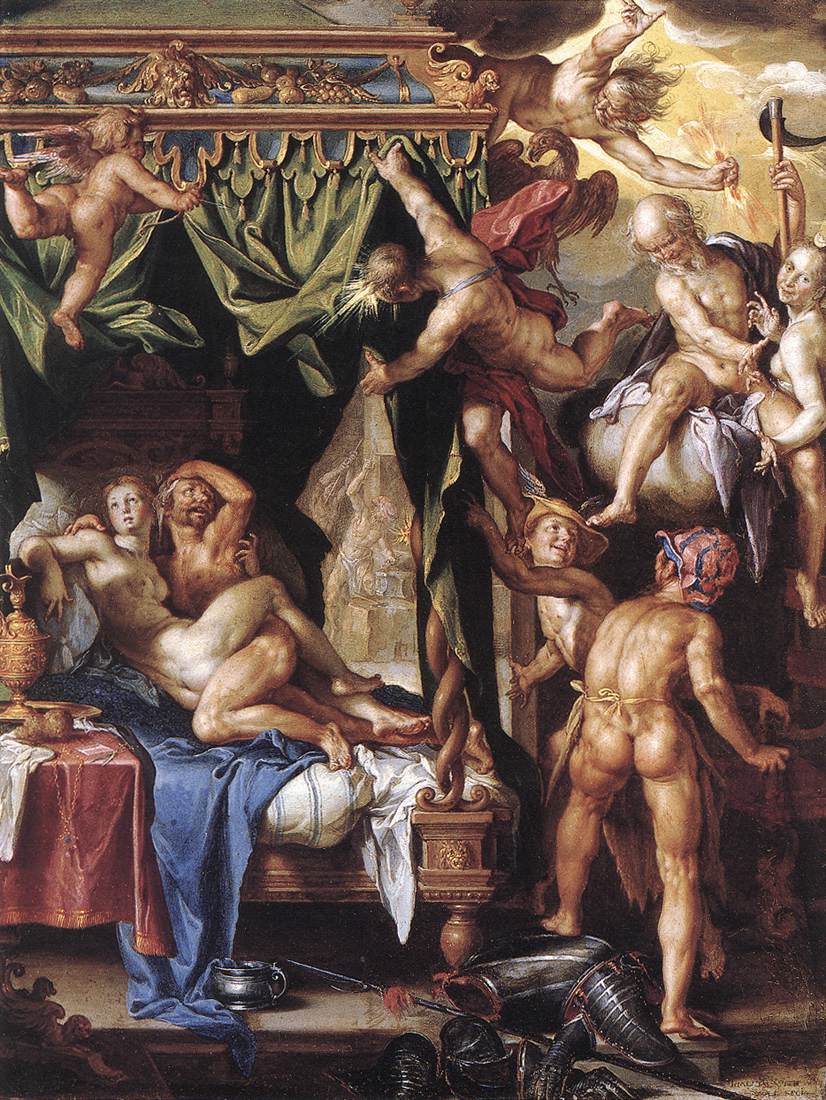
The malicious glee with which this story has been received by journalists reminds me of Wtewael’s Mars and Venus surprised by the gods: http://upload.wikimedia.org/wikipedia/commons/6/65/Mars_and_Venus_Discovered_by_the_Gods-Joachim_Wtewael.jpg

Sorry to quote Sir James Frazer two days running, but this in turn reminded me of what Frazer wrote about fertility rites surrounding ancient vegetation cults, and how they were later formalised into the legendary stories of classical antiquity ("…Mars was originally not a god of war but of vegetation... responsible for the harvest"). If we accept that John Terry is Mars in a new retelling of an old narrative, then this is how we expect heroic figures (who are different from mortals) to behave. If the narrative follows the set course John Terry will be untouched by the hysterical invective, will overcome his enemies, and will go on to "ascend to celestial heights" (however we interpret celestial heights in this context, presumably World Cup victory).

John Terry is already one of the most influential "role models" (I hate that expression) in the United Kingdom, and I can't see this episode damaging him in any significant way. If anything, his archetypal status has been confirmed (assuming I am interpreting Frazer correctly). It will be interesting to see how he overcomes this ritual setback-test and delivers tribal prosperity (not fertile corn and vines obviously, but possible a national "feel good").

I realise Frazer's work has been criticised, but the more I read him I am convinced that modern human behaviour has been determined thousands of years ago in the rituals of the prehistoric past. Everything is more or less fixed - attitudes, social organisations, the way we consume etc. Therefore the more we understand the past, the more we should be able to predict human behaviour.

You can get an idea of Guy Basnett's other work here: http://www.journalisted.com/guy-basnett

In 2008 Beyoncé Knowles produced this narrative which gives another view of the subject http://www.youtube.com/watch?v=eIkRiqxWcYU


Is Carole Malone the nastiest woman writing in journalism? Also, her writing is so bad and the things she says are so unsubstantiated. I hope the News of the World has given her a separate glassed-in cubicle - my idea of hell would be to share a general office with Carole Malone.

Monday, February 02, 2009

Rageh Omaar and the Crusades


Last night I watched the latest episode in Channel 4’s series about the history of Christianity. Even by the low standards of this series, this programme was awful. It was one of the most intellectually dishonest productions I have seen.

“War reporter” Rageh Omaar told us about the crusades – except that he didn’t. He told us a lot of half-truths, sixty-year-old versions of history and so many anachronisms I found myself saying “you idiot” out-loud to the television set. If this is the standard of accuracy Rageh Omaar works towards I will never trust another word he says.

Anachronism is when we judge a previous era by the standards of our own time. It is the one thing that historians (and also people claiming to present an accurate version of history) must never do. Instead you have to work hard to understand the mentalité of past generations, and see the world as they saw it (and if you can’t understand them, you should say honestly that you can’t understand them instead of pretending that you can).

Rageh Omaar made no attempt to understand the mentalité of either the crusaders or the medieval Islamic forces. Instead he told us how the crusades are perceived in the Middle East today, and then gave a very shallow “history” of the crusades that seemingly justified this view. There were so many errors I don’t really know where to begin.

The Rageh Omaar thesis is that the crusades were an early example of European colonialism. That they were horrifyingly violent and exactly comparable with the “holy war” of al qaeda today (this point was made repeatedly throughout the programme). That “the West” has only itself to blame for Islamic terrorism today because the crusades provoked it (oh, and Europeans are so ignorant they have “forgotten” the crusades – and therefore need the wise and enlightened Rageh Omaar to tell them how stupid and insensitive they are).

Rageh Omaar couldn’t make up his mind whether the crusades were nine hundred or a thousand years ago. He confidently asserted the crusades ended with the victory of Saladin (and were then “forgotten” in the West - whereas crusades probably continued until the 18th century). He seemed confused about the Knights Templars (crusaders were secular warriors who had taken a specific religious vow whereas the Templars were an order of fighting monks). He portrayed the initial impetus for the crusades as coming from Pope Urban II whereas they were a response to an appeal by the Emperor of Byzantium (the Byzantine territories were being over-run by expansionist Islamic forces). He was confused about what defines a “crusade” (utterances by President Bush do not count). He focused exclusively on the crusades as a clash between Christendom and the Islamic world.

This last point really needs to be challenged, as the idea of a clash between “East” and “West” is so erroneous as to completely undermine any credibility the programme might aspire to. The concept of “crusade” was a response by medieval Europe to the forces that threatened it from all directions. There were crusades to liberate the Holy Land (seen in terms of “patrimony”) but also crusades against the Islamic invasion of Spain, and crusades against the “pagan” Baltic areas. There were crusades against internal enemies such as the Cathars in southern France. The crusades did not stop after the victory of Saladin but continued for centuries afterwards (Chaucer’s Knight was a crusader; Henry IV went on a crusade to the Baltic before becoming king; there was a pre-emptive crusade against Egypt in 1365 etc). Riley-Smith has uncovered evidence of crusading (as legally defined, not the President Bush version) into the 18th century.

Various “experts” appeared in the programme, but the only one who had any credence was Christopher Tyerman (and why did the programme not include Professor Jonathan Riley-Smith, the greatest living authority on the crusades?). Rageh Omaar quoted “the chronicles” without understanding that medieval chronicles are not impartial historical accounts but often deliberately exaggerated (or even entirely false). He doesn’t even seem to have read the Damascus Chronicle of Ibn al-Qalanisi.

Does any of this matter? Isn’t history these days just a smorgasbord of “facts”, opinions and impressions picked from whatever Google throws up? Isn’t one person’s view just as valid as anyone else’s?

I don’t have the answer to these questions. Rageh Omaar is right that the West has become ignorant of its own history (as he unintentionally demonstrated through his own production). But he also revealed that the Islamic world is equally ignorant (but in a different way).

Just when you think Channel 4 can’t go any lower it has a habit of surprising you. This programme is the sort of trash you would think had been produced by the crazies of Channel EMTV (Channel 200 on Sky). How much longer is Channel 4 going to receive a public subsidy?

You can see the garbage for yourself: http://www.channel4.com/programmes/christianity-a-history

More on mentalité:
http://seis.bris.ac.uk/~clndgm/approaches/MENTAL.DOC

PS for such a self-proclaimed exponent of cultural sensitivity wasn’t it hypocritical of Rageh Omaar to point his cameras at the hooded Armenians in the Church of the Holy Sepulchre during their divine service – or is he ignorant about just how offensive this is to them?

Wednesday, August 27, 2008

Still beautiful


I was driving through the central hills on Saturday and took this photograph of fallow deer gathered under an oak tree. I think it is one of the best photographs I have taken. It seems to sum up the county in 2008 – still beautiful and unchanging.


Elsewhere the countryside is not in such good condition. This article (above - it you click on the image you should just about be able to read it) in the Observer is a piece of scare-mongering journalism that tells us the apple harvest is under threat because of changes to the Seasonal Agricultural Workers Scheme. Incredibly the journalist Caroline Davies makes no connection between low wages and lack of workers (was she too lazy to do the research, or did she willfully seek to mislead?).

We do not need to import cheap labour from Russia to pick English apples. All we need to do is pay a realistic wage for local people to pick the fruit. In any case, smaller family-owned farms always have a network of local people who come in to the farms to harvest crops – it’s the bigger farms that need hundreds of workers at rock-bottom wages.

The problem (once again) is the big supermarkets. They are prepared to flood the British market with ultra-cheap apples from the southern hemisphere (grown in industrial mono-cultures) if English apples cannot be produced at uneconomic prices. Why is the government so afraid of the four main supermarket chains (and why can’t they be broken up, with an anti-cartel clause that specifies no more than fifty outlets per chain?).

Personally I am unimpressed by complaints that food is too expensive (in real terms it is cheaper than it was two decades ago). We don’t need cheap food that encourages people to overeat. We need good-quality food locally produced and sold at a price that is fair to everyone.

Monday, July 28, 2008

The Sunday Times 27th July 2008

Normally on a Sunday I buy two newspapers, almost always the Sunday Telegraph and the Weekend FT, but sometimes the Sunday Telegraph and the Observer. Yesterday however, when I went to the shop, the only serious newspaper they had left was the Sunday Times. Rather than drive five miles into the town I decided to give the Sunday Times another go.

I say another go as I have tried with the Sunday Times in the past. I have tried and tried and tried. And it always seems to end with me hurling it away, exhausted at the tedium and disgusted with the shallow content.

Anyway, this time I decided I would work out why I don’t like the Sunday Times. Is it me or is it them? Or is it just an ingrained dislike of (the idea of) Rupert Murdoch that is preventing me from seeing the publication objectively?


On page two of the Sunday Times, below the Contents, the newspaper flags up its USP: “The Best Writers.” Also on the panel is an out-of-date tagline - the Sunday Times is your Sunday Papers. It’s a confident assertion of quality by one of the leading newspaper brands in the country (in the world in fact).

But is it true?

The five “best writers” listed are: India Knight, Rod Liddle, Rosie Millard, AA Gill, and Minette Marrin.


India Knight was educated at Wycombe Abbey (which has a high reputation for English). Her article on Mick Jagger contained clichés (“howls of derision” “adding to the nation’s gaiety” “lords of misrule”), sweeping generalisations (what is her justification for saying “Jagger’s baby-boomer generation has completely reinvented old age”?), and an odd condemnation of elderly demographics who are “wearing cardigans and waiting for death” (India Knight’s by-line photo showing her wearing a cardigan and the sort of floral print dress favoured by my late grandmother). This article didn’t tell me anything.

Rod Liddle was formerly editor of the Radio 4 Today programme (one of the most erudite of news programmes). He shared a page with socialite Tara Palmer-Tompkinson. In his half-page he poked fun at dwarves (done before, most memorably by Ricky Gervais), recycled the disappearing canoeist (done to death as a news item), told us about yet another loony council with bullying petty officials, recycled the (cheaply titillating) Max Mosley item, and produced a corner paragraph that had the sub-text: I hate Labour leaders (without telling us why, which might have been interesting).

Rosie Millard was formerly a BBC arts correspondent. Her article was an interview with the “gay bishop” Gene Robinson. Mildly sneering in choice of language (“holy beanfeast” “goad the boycotting bishops” “he’s even got Jesus backing him”). Mildly racist (African bishops are homophobic). Mildly funny camp portrayal of men in purple frocks getting in a tiswas. Such lazily stereotypical journalism you half-expected the Vicar from Dad’s Army to make an appearance in the article, saying Oh you silly man!

AA Gill is the author of a thinly-disguised autobiography The Angry Island. His self-hatred is externalised by a superficially brilliant (luminous, dazzling, shining) prose style that is ultimately depressing because he hasn’t got anything good to say about anyone or anything. Even when he appears to be saying something nice (for instance, a review of The Wire) if you read the piece again you see he is being nasty in an ironic way.

Minette Marrin is a popular journalist (shortlisted for Columnist of the Year at the 2004 Press Awards). Her article was a polemic advocating disestablishmentarianism masquerading as an attack upon Islamo-fascism. She used a mishmash of statistics (“only a tiny minority” “a startlingly large proportion” “four out of 10 Muslim students in Britain” “almost a third” “40% said they felt” “nearly a quarter do not think” “a quarter of Muslim students” “57% said they should and a further 25% said they were not sure” “more than half” “a third don’t think or don’t know” “a third said they were” “more than half” “these are large minorities” “one can hardly doubt the findings of the YouGov survey” “fully 42% said they weren’t sure” “one in five wasn’t sure” “one in six” “while three in 10”).


The Sunday Times is edited by John Witherow with weekly interventions by Rupert Murdoch (and presumably James Murdoch).


“You MUST read…” - I suppose this sums up what I feel about the Sunday Times. It is a publication that is continually telling you what to do and what to think. Without explaining any reasons why.

Tuesday, July 15, 2008

Knife crime from a marketing perspective


Above: not keen on David Aaronovitch as a columnist - he has a contrarian style that is very irritating.

“Debate” on the propensity of young people (especially young men, and especially in urban areas) to carry knives and stab each other has reached almost all sections of the media, and is threatening the uneasy political consensus on the subject.

The consensus is that “we still don’t know” (David Aaronovitch in today’s Times) why young men are carrying knives, still less why they are using them. All (mainstream) political opinion subscribes to this collective myopia. If pushed commentators will say “Society” is to blame because of the bleakness and inequality of inner city urban life (this is a very convenient position to take, since if “everyone” is to blame then it follows no-one is to blame, and therefore there is no need to do anything).

Looking at knife crime from a marketing perspective (which is the only way I am qualified to look at it) there seems to be chronic obfuscation over the issue of demographics (which is of concern, since if you do not target your audience properly only by accident will your message get through to them).


Yesterday’s Guardian told us that according to a report by Manchester University’s School of Law there were no defining characteristics of gang-related knife crime and that the position was hopelessly “messy” (the report based on 100 interviews with gang members carried out in an anonymous city - it is possible this city might be somewhere particularly un-diverse such as Exeter or Lincoln or Winchester).


Saturday’s Guardian devoted several pages to five in-depth case-studies on perpetrators of knife crime, none of whom fitted "the usual stereotype". These case-studies troubled me since they were so much at variance with the accustomed image. I thought possibly it was an Orwellian attempt to portray as “reality” the opposite of reality. Or possibly it was an attempt to even the balance since one particular community has had so many fingers pointed at it. Nevertheless, the picture presented by columnist Erwin James was troubling because it was at variance with my perception of the evidence.

And what is the evidence?

One national newspaper (either the Independent or the Guardian) published a portrait of every victim of knife crime in London over the last year. Immediately you could recognise a defining demographic according to age, ethnicity and social group. To pretend otherwise is to deny the obvious.

Occasionally you see heavily coded attempts to discuss this demographic without actually naming the target audience - for instance, politicians will give unqualified praise to “the projects of Camila Batmanghelidjh”.

Occasionally interviewers will ask questions. Gavin Esler in Newsnight yesterday asked an inner city social worker about “black on black” crime but the social worker just ignored the question (Jeremy Paxman wouldn’t have let him get away with this). The rest of this interview consisted of a talking head (on a screen) from the government and two studio guests who fitted the “dead white males” category, all of them talking round the problem in an extremely oblique way.

So from these scraps of evidence, gained in an extremely circuitous fashion, I have attempted in marketing terms to “define the situation”:

Target audience - young (sometimes very young) black men, social class C2, D and E, living mainly on inner city social housing estates in London and other major urban centres.

Characteristics - formed into internally-sociable peer groups, possessing a considerable sense of loyalty, they have developed sophisticated local cultures defined in ritual behaviour and fashion, visual/musical expression and an impenetrable linguistic dialect. They have a romantic self-image of themselves as “doomed”. Over recent years this demographic has taken a deliberate decision to arm itself - generally with knives and swords, increasingly with guns.

Wider cultural resonance - the “death or glory” ethos is a recurring theme in western societies with a succession of role models (Tybalt the “prince of cats” in Romeo & Juliet; Rupert Brooke going to war as if “into cleanness leaping”; James Dean’s death wish of speed and excitement etc). It is not surprising that young black urban men should develop their own “anthem for doomed youth” narrative that tells them they have a heroic (but doomed) destiny. If anything this demographic should be applauded - alone and unaided they have achieved Maslow’s goal of self-actualisation and invented (out of nothing) a world where they feel valued and fulfilled.

Because the lifestyle they have adopted is based on self-actualisation it cannot be changed by appeals to conform to mainstream values (even “the projects of Camila Batmanghelidjh” are unlikely to have much effectiveness, except at the margins and among those who did not buy the lifestyle in the first place). Probably the demographic lifestyle will have to be subverted from within, with the selling of a more attractive lifestyle that satisfies their desire for “death or glory” but without anyone actually getting hurt.

On a practical and immediate level the demographic must be disarmed. If they are not disarmed then other demographics will choose to arm themselves (and I guess this is already happening) with the logical conclusion that everyone in society must be given the right to bear arms. Even at the risk of renewed local rioting, the police must urgently take the weapons away.

Anyway, that’s how I see things. I have tried to be dispassionate, but this situation represents significant failure at a number of levels. Failure of political leadership, failure of community leadership, failure of policing policy in London, failure of the segregation policies of multi-culturalism, failure of the self-censorship of political correctness, failure of a materialist consumerist society that promises self-actualisation through material goods (actually not possible) then denies certain demographics the ability to consume those material goods.

I didn’t like this at first, but it grows on you: http://www.youtube.com/watch?v=IxR4AweLeXE