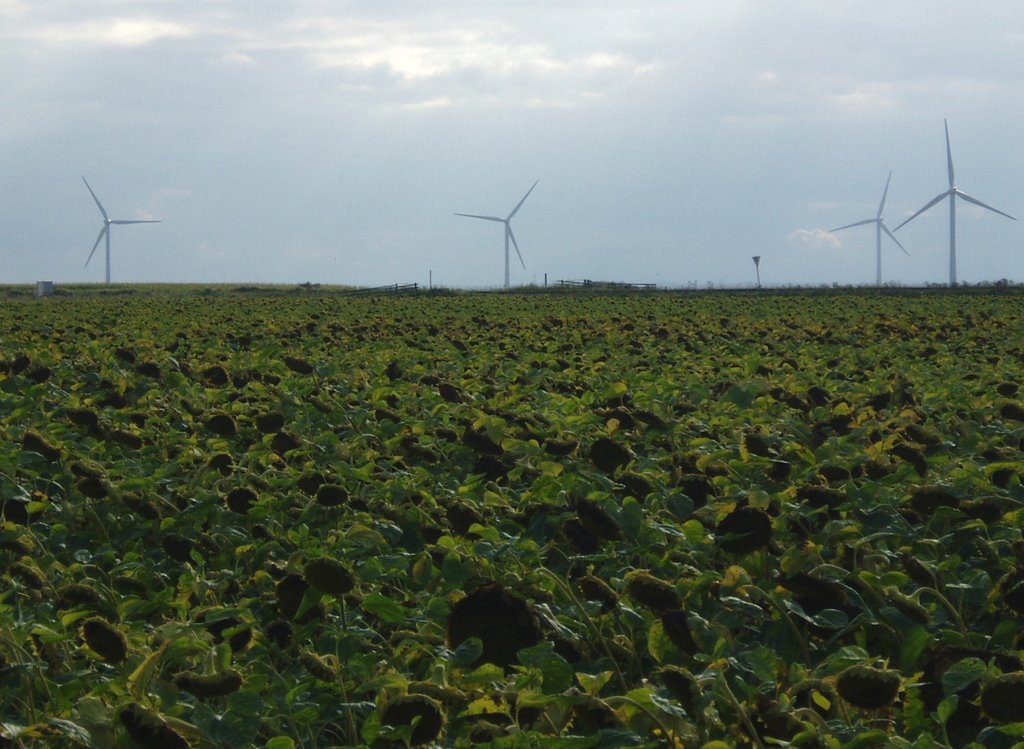
The place was packed with people who had brought along apples to be identified.
In front of me in the queue was an elderly couple clutching a small cardboard box filled with apples. They were wearing identical beige-coloured raincoats. The woman’s hand was on the man’s arm.
“We’ve recently moved into an old house with an overgrown garden” the man said. “We have ten apple trees in the garden. We are hoping someone can tell us what they are.”
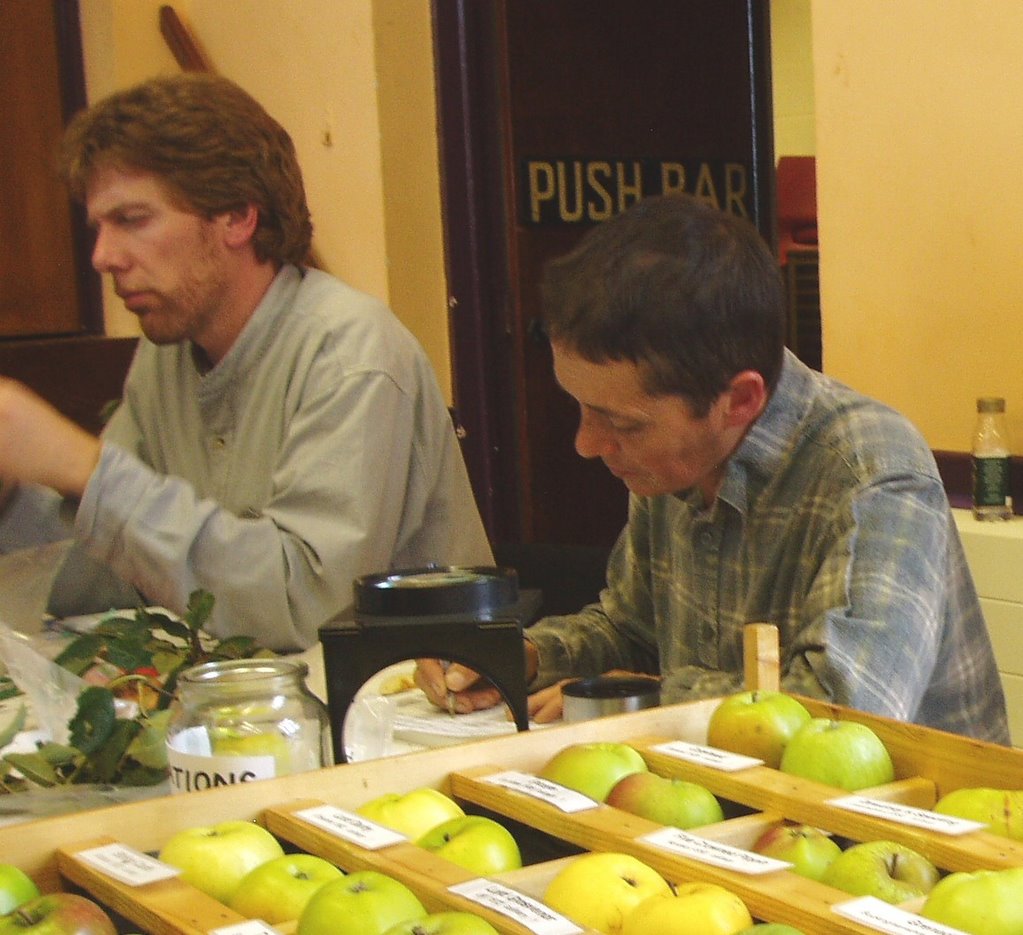
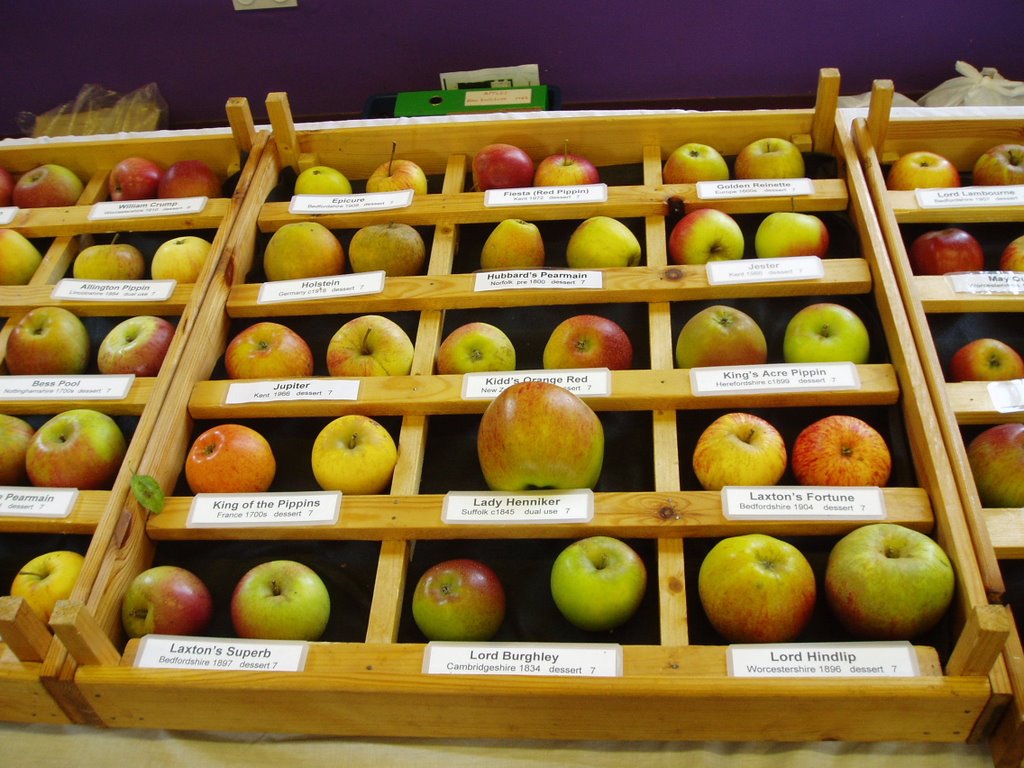
Above: There are a huge number of apple varieties – approximately seven thousand five hundred. The Guardian recently did a free wall chart on apples which was very feeble – it only showed about forty varieties, half of which were the mono-culture varieties sold by the supermarkets. At the Apple Day there were about a hundred and twenty different apples on show.

Above: The Merton Beauty apple was first grown by a Mr Crane in 1932 at the John Innes Horticultural Institute in Merton, a suburb of south London. The tree is easy to grow and gives a good crop - aromatic apples tasting slightly of aniseed. Not to be confused with a Camberwell Beauty, which is a butterfly.

Above: Nonpareil is a variety introduced from France, probably in the 17th century. They are small apples, yellow-green in colour with streaks of brown russet and a faint orange flush. French scientists claim that the typhoid bacillus will not live in the juice of the Nonpareil apple.
Nonpareil means “unmatched” - there is a bird called the Nonpareil (http://www.oiseaux.net/photos/barry.kent.mackay/passerin.nonpareil.2.html) as well as a type of almond and a kind of sugar confection used to decorate cakes.
In A la recherché du temps perdu Marcel Proust wrote: “To return to Combray, we need only turn down an avenue of oaks, bordered on one side by a series of orchard-closes, each one planted at regular intervals with apple-trees which cast upon the ground, when they were lighted by the setting sun, the Japanese stencil of their shadows; then, sharply, my heart would begin to beat, I would know that in half an hour we should be at home…”

Above: Claygate Pearmain is a wonderful apple, crisp and heavily scented. The taste is very nutty. It was discovered by accident growing in a hedge in Surrey about a hundred and eighty years ago. In appearance the fruit is large, with red stripes and russet polka dots. Edward Bunyard (a very opinionated writer on the topic of apples) describes it as one of the top twelve finest apples in the world. It used to be widely grown in Victorian and Edwardian gardens but has now become quite rare. There is an old county remedy for sore eyes that involves rotten Claygate Pearmain apples used in a poultice.
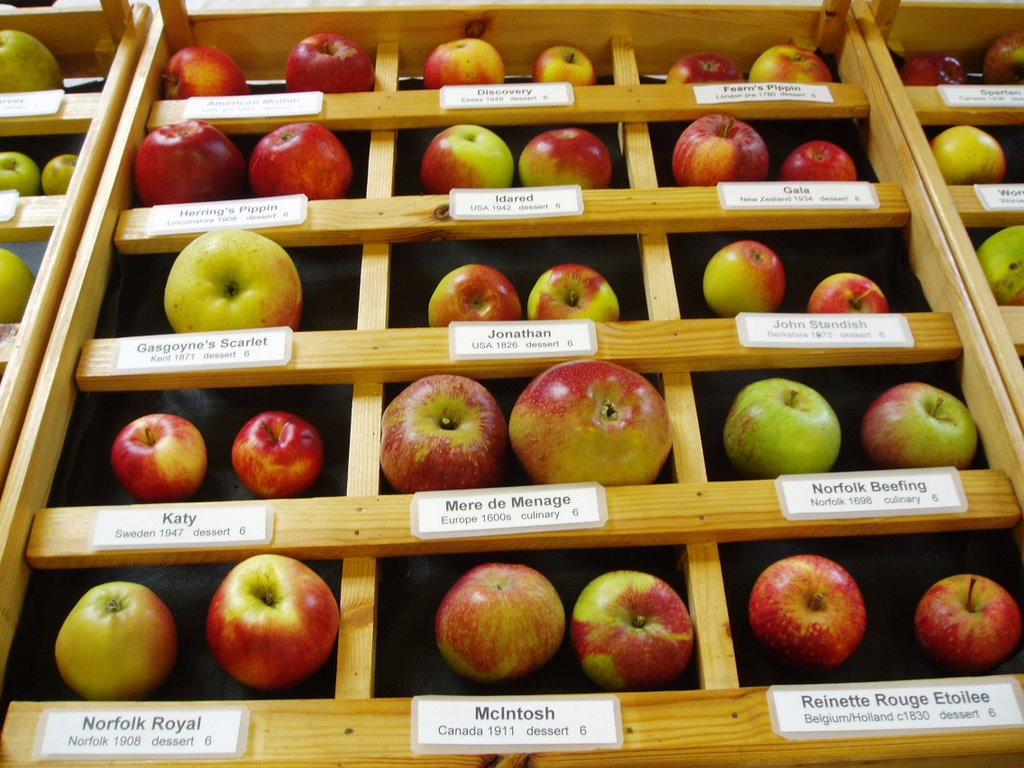
Above: Gascoigne’s Scarlet was first grown by W. Gascoigne of Bapchild Court in Kent. As the name implies, the colour is a deep blood red. It keeps well (picked in September, it will last until January). Apparently it is good for growing on chalky soils. It is a “duel purpose” apple which means it can be used for cooking (apple pies, apple dumplings, apple puddings etc). Shakespeare’s Henry IV mentions a dessert made from apples and caraway.
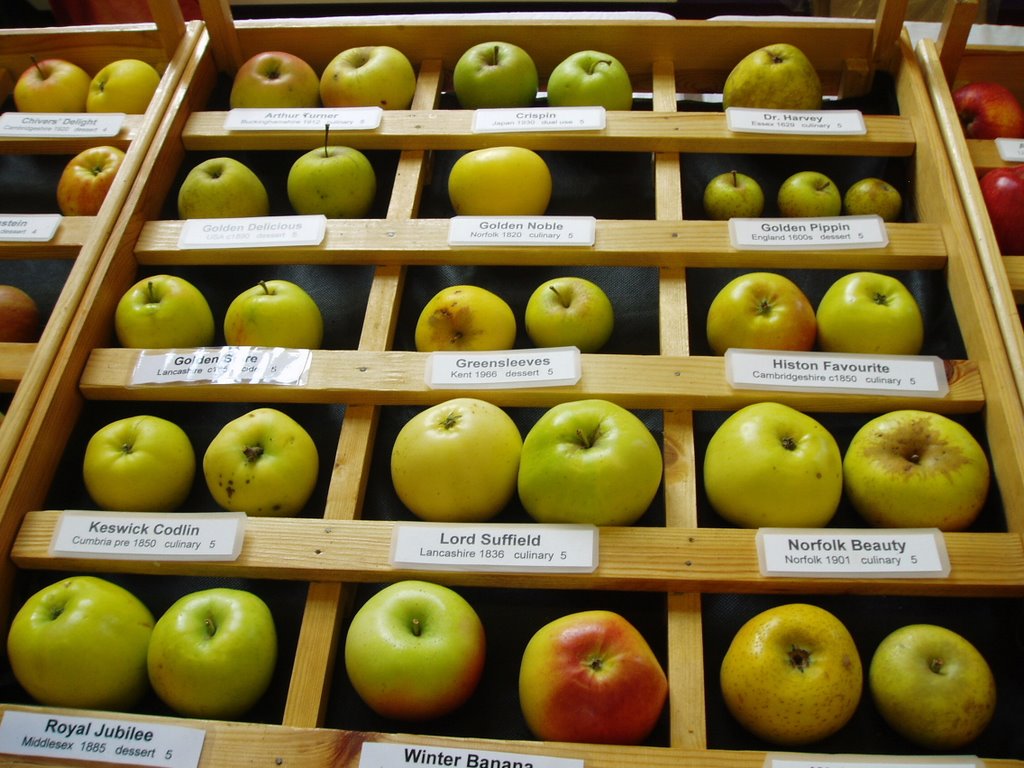
Above: Histon Favourite is a yellow apple first grown by John Chivers (from the famous jam family) around 1850. It has a sort of acid taste that the experts describe as “brisk” (Bunyard describes it as “indiscriminate and undistinguished”). It was widely grown in Cambridgeshire to supply the London market.
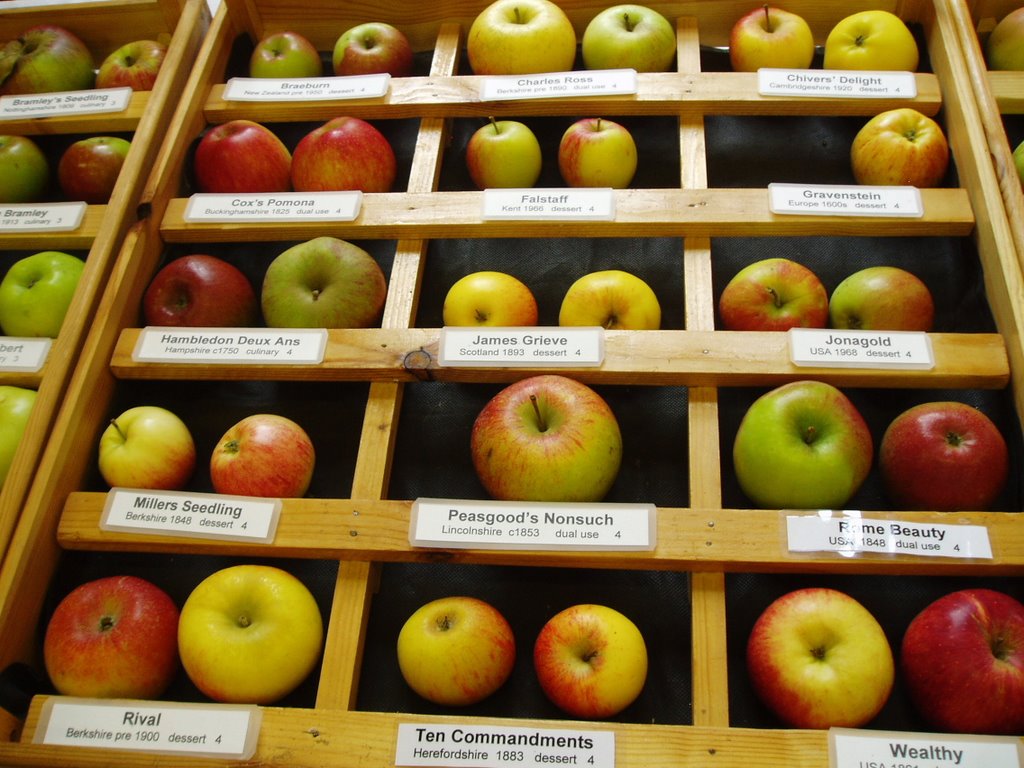
Above: Peasgood Nonsuch was grown by accident by a sixteen year old girl who planted five pips from an unknown cooking apple. Only one of the seeds germinated and eventually produced gargantuan apples, each apple over a pound in weight. Many families in the county used to plant an apple tree whenever a son was born (and a pear tree for a daughter).
Sir James Frazer records rituals that accompany the tasting of the first-fruits of the apple crop each year. Unless these ceremonies are performed there is a danger that the “tree spirit” may be offended. Frazer also mentions how a straw man would be placed in the boughs of the oldest tree in an orchard, representing the tree spirit that would revive when the blossom appears in the spring.

Above: Reverend Tom Putt, Rector of Trent near Sherborne, is supposed to have first grown the famous Tom Putt cider apple in the late 1700s. Orchards of Tom Putt apples can be found all over the west country. “Wassailing the orchard-trees”' on Christmas Eve is a custom that still survives in the west (it used to be widespread in all counties). Farmers go into the orchards at night accompanied by their families and drink to the health of the trees in cider before throwing the remainder of the drink onto the tree trunks. Shotguns are fired into the branches, and special songs sung. Wassailing bowls were very ornate (http://www.swanseaheritage.net/article/full.asp?ARTICLE_ID=207).
Cider apple vinegar is a powerful detoxifying and purifying agent – you can buy a very pure version by mail order from Goldshield (http://www.goldshield.co.uk/products-ST02632-CV02/Cider-Apple-Vinegar.htm).

Above: Cider press in operation. Recently on Film4 I watched the 1998 film version of Thomas Hardy’s The Woodlanders, directed by Phil Agland and starring Rufus Sewell. It is set in the New Forest in the nineteenth century and includes a very effective scene where woodsman Giles Winterborne holds a party in his humble home hoping to impress his promised fiancée (in a sort of arranged betrothal) Grace Melbury. The yokel neighbours also invited to the party become excessively inebriated with cider, and their drunken behaviour so disgusts Winterborne’s prospective father-in-law that the match is broken off (with tragic results). The drinking is not mentioned in the novel and is one of the few occasions where a film has improved upon a book. The Woodlanders is supposed to have been Hardy’s favourite among his novels.

Above: I usually stop at roadside stalls to see what they have on offer. In September I bought some incredible carrots – they must have just been pulled out of the ground. We had them at dinner and they were very succulent, completely unlike any carrots I have had before (I suppose most carrots get a bit dried out when being transported to the supermarket).

Above: Crab apple jelly. Crab apples are wild apples that are tiny in size and extremely sour (the final jelly is very sweet, copious amounts of sugar having been added when the apples are boiled up). Almost every farm has its own recipe for crab apple jelly, many involving alcohol.

Above: Baskets of windfalls were lined up for you to help yourself.
Apples feature prominently in mythology. The Trojan War began when Paris gave an apple to Aphrodite. The legendary Isle of Avalon is supposedly the “Island of Apples” (traditionally located at Glastonbury which is an area noted for its apple orchards). Eve tempted Adam with an apple from the Tree of Knowledge (more likely to have been a pomegranate as the Middle East is too hot for apples to grow).
In the medieval period a relic purporting to be the apple given by Eve to Adam appeared in Egypt and was venerated at a church in Alexandria (Sir John Mandeville makes an oblique reference to this). It was stolen in 1365 during the Alexandrian Crusade and conveyed to Cyprus, and then Malta. According to notes left by Canon MVG (an amateur antiquarian, therefore not entirely reliable) it later shows up as one of TWO holy relics at a Cistercian house in Wales, one relic being the apple from the Tree Of Knowledge, the other being an apple from the Tree Of Life. The credibility of these two objects doesn’t seem to have been very high, even in medieval times, and the cult following was negligible. At the Reformation both of the apples are supposed to have been put in a box and sealed in a wall of the monastery, identified by MVG as Strata Florida. However in 1998 I stayed with Alan Nixon at his home in south Wales (the MVG papers belong to his family) and we thought that Cymer Abbey might be a better candidate. We drove up there the next day (if you have ever travelled from south Wales to north Wales you will understand what a difficult journey that was) but it was a wasted trip – there were hardly any walls of the abbey left standing, and none of them seemed wide enough to contain a hidden box. Had we found a box would we have dared open it? The apple from the Tree Of Life would be a relic that even an M. R. James character would have been wary of.