Showing posts with label Ice cold project. Show all posts

Thursday, January 06, 2011

Cooler Than Me by Mike Posner


Above: screen print 1 from the video.

At number 16 in the music chart this week is Cooler Than Me by Mike Posner.

The use of the word “cool” is a subject that interests me (coolness as a brand attribute is very valuable, if you can get it right). Mike Posner defines coolness as the moment of being snubbed by someone you are attracted to. As Mike Posner has a degree in sociology possibly he has put some thought into this definition.


Above: screen print 2 from the video.

The video for the song was directed by Jason Beattie. He shows Mike Posner at a party in the Hotel Roosevelt in Hollywood. Borrowing designer sunglasses from different people Mike Posner sees the party through different viewpoints – joyful dancers, serious intellectuals, naked girls bouncing on a bed etc.

It’s a clever concept.

http://www.youtube.com/watch?v=7S_H1KDjW9Y
http://www.jasonbeattie.com/index.php?/admrktng/red-bulletin/

Thursday, May 20, 2010

An idea you can trace back to Homer's Illiad


Above: a couple of weeks back Turner prize-winning artist Grayson Perry fulminated about the concept of coolness. It is a position I have some sympathy with, since the use of "cool" as an acclamation is inherently unfair. However, just because we disapprove of something doesn't mean it will go away.

I also think Grayson Perry has got some of his assumptions wrong. Cool is more than just an expression of teenage approval, and is a pervasive concept that regulates society (or sub-groups within society - what Seth Godin would delineate as "tribes"). The concept of Cool relates to ethics, logic and the philosophy of language.

It's an idea you can trace back to Homer's Illiad.


Above: an example of the power of Cool can be seen in the Demos report on terrorism and how it can be countered by addressing the "cool factor".

As the Victorians taught us, if you can measure something you can control it.

Wednesday, April 28, 2010

“Voting Tory is quite cool”


Above: this appeared in the Daily Mirror – I forget which columnist.

Dermot O’Leary is reported to have asked Conservative Leader David Cameron “Do you think it can ever be cool to be a Conservative?” This was a trick question, as generally politics in the United Kingdom is “uncool” (and we should keep it that way). But there are a number of implied issues in the question.

Does it matter to young people whether the people they vote for are cool or not? If yes, why does it matter? And is Dermot O’Leary through his question raising the fear among young people of being “uncool” if they vote Conservative?

Does it actually matter if politicians are uncool? Is coolness significant in a political context? Is it possible to marshal the characteristics of coolness in support of a political movement (the only examples I can think of are foreign – John F Kennedy, Barack Obama, Gabriele D'Annunzio etc)?

By my reckoning there are only about five hundred cool people in the public sphere in the United Kingdom, so presumably it would be possible to recruit them to a political cause.


Above: an interview being set up on College Green (an area of grass opposite the Houses of Parliament – the path you can see features prominently in “establishing shots” of politicians).

An answer to Dermot O’Leary’s question was provided by the Today programme this morning. Writer Will Self presented a short item, recorded among the mainstream interviews on College Green, on “absurdist” performance artists who are using the general election as a backdrop for their art. One of these avant-garde artists (I think he was a Situationist) told Will Self “voting Tory is quite cool”.


Above: picture of Dermot O’Leary that appeared in an advertisement in Sky magazine. Possibly his head is over-large. I keep asking myself whether there is such a thing as a cool aesthetic.

More on Situationists: http://www.artandpopularculture.com/Situationist_International

Monday, March 29, 2010

I have abandoned Twitter for a second time


Above: use of the term on the cover of The Observer magazine. Coolness is combined with the word chic (defines appearance) and untouchable (defines accessibility).


Twitter has defeated me again. After a relaunch I was using it as an informal notebook as I researched the cultural meaning of the word "cool". I was beginning to make progress, collecting examples, jotting down ideas, organising thoughts.


As an uncool person myself, bemused for years as to what exactly (exactly) "cool" means, I felt I was close to the philosopher's stone of defining (and thus controlling) the acclamation cool.

But I began to notice my “tweets” (that word still makes me feel uncomfortable – yet another reason why I will never be thought cool) were disappearing. One tranche of tweets vanished and I managed to restore them from notes and partial memory. Then another, much larger sequence dropped off my site.


It seems that Twitter is unstable, and this is happening to hundreds of people. Thoroughly disillusioned, I have abandoned Twitter for a second time, and will continue my pursuit of “cool” via occasional posts on this site.


Above: journalist Hadley Freeman also uses the word cool in association with the idea of certain people being untouchable or unapproachable.


Above: Sky magazine. Hang 10 is a surfer expression that means "When a man whose penis is over 10 inches walks around naked" (I havn't made this up). Unlikely I will actually watch the series.


I can't help thinking Cavafy summed all this up years ago:


In his tomb - ornately designed,
The whole of syenite stone,
Covered by so many violets, so many lilies
Lies handsome Evrion,
An Alexandrian, twenty-five years old.
On his father's side, he was of old Macedonian stock,
On his mother's side, descended from a line of magistrates.
He studied philosophy with Aristokleitos,
Rhetoric with Paros, and at Thebes
The sacred scriptures. He wrote a history
Of the province of Arsinoites. That at least will survive.
But we've lost what was really precious: his form
Like a vision of Apollo.

Thursday, March 11, 2010

Twitter and the anatomy of “Cool”

Two weeks back I thought I would give Twitter a go. As a media channel it has passed the “early adopter” phase and is now mainstream (even middle-aged teachers are writing about it in Education Guardian). Other people I knew had started using the site, so it seemed a good time to try it out.

Anyway I set up my Twitter account and started posting. But for various reasons I couldn’t get the hang of it. The 140 words was too constricting for me, and changed the meaning of most things I wanted to say. I never got round to updating by text from my mobile phone (which would have added an extempore quality). I was unsure about the frequency. The overall example of Stephen Fry seemed too intimidating.

After about a week my Twitter site was a burden to me. It was like a mouth that needed constant feeding. So I just deleted it.

But it has been on my mind ever since. Perhaps I had blotted out my site too hastily? Perhaps I should have another go?

It also occurred to me that rather than just write whatever rubbish came into my head I should give my new Twitter facility a theme.

And in one of those “ping” moments, the idea came into my head to use Twitter as a notebook for a project I am working on.

The Ice Cold Project

Several weeks ago Yvette (my boss, a tremendous woman in every sense of the word) gave out assignments to each of us, designed to build new selling points for the agency. She wanted us to offer things no other agency could offer. Most of these “added value” attributes were intangibles.

The intangible quality I was asked to work on was “Cool”.

Initially this caused me to panic. I am one of the last people to know “what’s hip, what’s happening, what’s now”. Still less would I know how to take the quality of “coolness” and build it into a customer’s brand.

But one cannot say “no” to Yvette.

So I approached it as I would any other research project. I set parameters. I defined criteria. I identified methodologies. I recorded perceptions, and graded those perceptions according to demographics (age, gender, geographical location etc). I asked the same question two or three times, with slightly different wording, to ensure consistency. I began to look for patterns (but without jumping to conclusions).

It has turned out to be one of the most fascinating exercises I have ever attempted.

It has also been a lot easier to research than I thought.

All I do is ask the question: Who is the coolest person you know? (with the secondary question: and why?).

I also needed a system of classification, and have decided to use the names of Greek city states of the classical period – mainly because it is a short-hand I can easily remember, and is more coherent (for me) than numerics.

I have set up my Twitter account (called Anatomy of Cool in homage to Robert Burton) and I am hoping complete strangers will contribute to the list. Please remember that the coolness of any individual rests entirely in the perception of others and the reasons they give. No endorsement (or otherwise) is intended.

As well as cool people, I am also going to list “facilitators” since society is not a vacuum – cultural facilitators, economic facilitators, political facilitators.

Anyway, I have listed some thoughts below. They are not finished ideas by any means, and I anticipate this project taking me another year at least. But somewhere in there I think will be “the answer” (which I am also hoping might be worth some money, so I am holding a few things back).

Caveat – I am aware that many people have written on this subject before, and although I have looked at some of this, I have decided to start completely fresh. I am not really looking at what style gurus call cool. I am interested in what ordinary people consider cool and why.

Aspects that seem to define a cool person:

1 A cool person is someone who changes their immediate environment (and in certain circumstances wider environments, including occasionally global environments).

2 Generally cool people are not influenced by what other people think.

3 A cool person has a strong internal commentary and generally believes other people think the same way as he/she does.

4 Cool people do not depend on acquired knowledge, they need to think things through for themselves (even though their thinking may not be very deep).

5 Cool people do not trust the judgment of others, they MUST reach their own conclusions, whether on choice of music, choice of political party, fashion, moral behaviour, attitudes towards others, issues of expression etc.

6 All cool people are brave – this is a fundamental quality.

7 Cool people are not ambitious, generally they accept the surroundings they find themselves in, the people they meet, the things that happen to them.

8 You cannot be self-consciously cool – this is a fundamental quality.

9 Cool people are progressive in the sense that they have to make order out of the chaotic circumstances they find themselves in.

10 On the whole cool people have rational minds and can justify the choices they make.

11 Facial expressions of cool people convey a “look” that either subdues or impresses others (need to do more analysis on this).

12 Coolness has different qualities according to age. The coolness of children is different from that of teenagers, which in turn is different from fully adult people. Elderly people generally are not cool (but there are exceptions). Cool people make their age group “enviable” and endow their generation with an effortless attractiveness. Currently unclear whether cool people can pass from being cool in youth to being cool in a later age group. A lot more work needs to be done on age groups.

13 Cool people are irresistible – even if you have misgivings about their character you find it difficult to resist them.

14 Cool people are agreeably stimulating and agreeably provocative – this is a fundamental quality.

15 Cool people have the power of pleasing or entertaining people (“charm” although this is a very imprecise description).

16 Cool people break rules – this is a fundamental quality.

17 If cool people conform with a particular aspect of society they do this because they have internally decided that they want to conform.

18 It is hard work being cool as they have to think out everything for themselves, and then integrate it into their world view.

19 Cool people do not care about the opinions of others, all that they are bothered about is their integrated view (it is this integrated view that drives them to behave in a particular way).

20 Cool people are unpredictable – this is a fundamental quality.

21 Cool people have huge powers of resistance to the way the world enforces conformity.

22 A cool person has a character that is absolutely integrated, and they never contradict themselves (possibly this is why younger people are cooler, because they have not made so many compromises with the world).

23 Cool people seem to be symmetrical – I need to do more work on this idea.

24 Cool people have a top down immediacy in which you can see them for what they are, rather than people you build up their image and reputation action by action.

25 In a sense cool people are pointillist – individual actions in themselves are not so cool, but the total picture when seen at a little distance is overwhelmingly cool. Therefore can we say coolness has a tipping point at which it is achieved?

26 Cool people are interested only in the future.

27 Cool people are formative people in any sub-section of society, and are the people who appeal to the collective imagination of that sub-section.

28 Great people do not become cool, cool people become recognized as great (unproven – I’m not sure how valid this is and need more data).

29 Cool individuals create an impact through being copied.

30 A creative society is made up of cool people being cool.

31 Cool people are spontaneous.

32 Cool people rely on instinct.

33 Cool people have a perfection that never lapses - this has great power over others.

34 Coolness has a perpetuating quality – those who become cool gain ever greater strength to remain cool.

35 You cannot be indifferent to coolness – if you are not cool yourself you are affected by the presence of cool people.

36 The presence of cool people enhances non-cool people, and thus they become very popular and celebrated (but coolness is not popularity nor is it celebrity).

37 Can coolness be generated (or self-generated)? This is a key question. I am beginning to see how it might be faked.

38 There are no more cool people in the world now than there ever were. Coolness has always existed as a given percentage of a society’s population. As cool people emerge in new sectors, so other people become uncool in others.

39 Coolness is not without its cost. Cool people suffer, they have blocks put on them, they are despised.

Tuesday, March 09, 2010

Skater


Walking through Bloomsbury, suddenly this pack of rollerbladers came past (if you click on the picture it enlarges so you can see more detail).

I knew more and more people were taking this up as a sport, but this was the first time I had seen it happening in public.

Probably Jamie Stenner is the most influential "skater" in the United Kingdom (apparently you are not supposed to call them rollerbladers). Influential in terms of personal style. Guy Crawford is long gone.

Thursday, February 04, 2010

Product placement

Update: it seems that there is only a partial ban against product placement, so the news is not as good as I thought it was.

Really good news that Health Secretary Andy Burnham has succeeded in stopping product placement on British television, against the advice of Culture Secretary Ben Bradshaw. This is the second time Andy Burnham has blocked product placement proposals – he formerly did so when he was Culture Secretary himself. Product placement has been proposed as a way of bringing in extra income for the supposedly ailing commercial television sector (the TV companies are ailing because they are not making programmes audiences want to see).

Product placement is when branded products appear in productions as if by accident. In reality the product shots are paid for. Product placement is more powerful than conventional advertising because the products featured appear to be endorsed by the credibility of the programme and the glamour of the people appearing in it.

An example is Lady Gaga'a video (directed by Francis Lawrence) for Bad Romance: http://www.youtube.com/watch?v=qrO4YZeyl0I A few seconds into the film you can see bottles of Lex Nemiroff vodka. Impressionable people who want to be like Lady Gaga will think she drinks that brand of vodka, and will be motivated to do the same (if they can find it in the United Kingdom).

It goes with out saying that product placement corrupts. If it is done clumsily it distorts the programme. If it is done well it is advertising to people when they are off-guard.

Labour apres le deluge

Obviously Labour is going to lose the next election, and I hope (for their sake as much as anything) that they lose by a big margin and have a clear-out of their top team. In this context, Andy Burnham would be a good choice of leader. He may not be a firebrand orator, a “two-brains” ideas guy, or even a ruthless party in-fighter, but he has the priceless quality of looking and sounding ordinary.

The only other two contenders who come close are David Miliband and James Purnell, but both these individuals have question marks over them.

But I must emphasize that I am not a Labour Party member, and I am looking at this entirely from a presentational point of view.

Sunday, January 31, 2010

John Terry in the News of the World


Above: gigantic image of John Terry that appeared in the Guardian last year.

With predictable cynicism the News of the World (a Murdoch publication) has used the new ruling against super-injunctions to gain permission to publish a "scoop" of such intrusive personal nastiness that it is a wonder the writer Guy Basnett can get away with this sort of thing. Other writers have rushed to give their sanctimonious opinions, although it is unlikely that their own private lives would withstand the same degree of scrutiny. The story illustrates what is wrong with the British newspaper industry in general and the Murdoch press in particular.

The report (spread across several pages) details how England football (soccer) captain John Terry is having / has had an affair with the wife of a friend. Several grainy photographs illustrate this article. The views of John Terry's own wife are not clear.

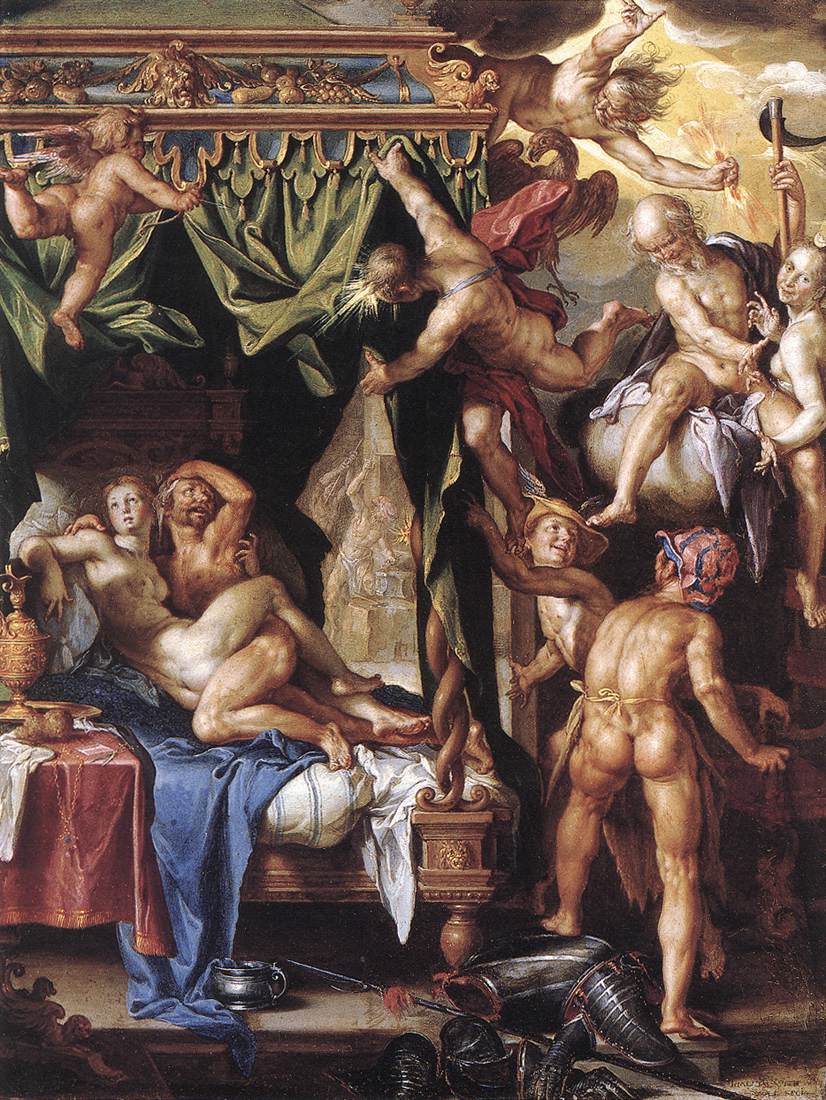
The malicious glee with which this story has been received by journalists reminds me of Wtewael’s Mars and Venus surprised by the gods: http://upload.wikimedia.org/wikipedia/commons/6/65/Mars_and_Venus_Discovered_by_the_Gods-Joachim_Wtewael.jpg

Sorry to quote Sir James Frazer two days running, but this in turn reminded me of what Frazer wrote about fertility rites surrounding ancient vegetation cults, and how they were later formalised into the legendary stories of classical antiquity ("…Mars was originally not a god of war but of vegetation... responsible for the harvest"). If we accept that John Terry is Mars in a new retelling of an old narrative, then this is how we expect heroic figures (who are different from mortals) to behave. If the narrative follows the set course John Terry will be untouched by the hysterical invective, will overcome his enemies, and will go on to "ascend to celestial heights" (however we interpret celestial heights in this context, presumably World Cup victory).

John Terry is already one of the most influential "role models" (I hate that expression) in the United Kingdom, and I can't see this episode damaging him in any significant way. If anything, his archetypal status has been confirmed (assuming I am interpreting Frazer correctly). It will be interesting to see how he overcomes this ritual setback-test and delivers tribal prosperity (not fertile corn and vines obviously, but possible a national "feel good").

I realise Frazer's work has been criticised, but the more I read him I am convinced that modern human behaviour has been determined thousands of years ago in the rituals of the prehistoric past. Everything is more or less fixed - attitudes, social organisations, the way we consume etc. Therefore the more we understand the past, the more we should be able to predict human behaviour.

You can get an idea of Guy Basnett's other work here: http://www.journalisted.com/guy-basnett

In 2008 Beyoncé Knowles produced this narrative which gives another view of the subject http://www.youtube.com/watch?v=eIkRiqxWcYU


Is Carole Malone the nastiest woman writing in journalism? Also, her writing is so bad and the things she says are so unsubstantiated. I hope the News of the World has given her a separate glassed-in cubicle - my idea of hell would be to share a general office with Carole Malone.

Monday, January 18, 2010

Charismatic


Above: the West Lodge Hotel near Cockfosters.

On Friday evening I met friends for dinner at the West Lodge Hotel in Cockfosters (a country house hotel in a large park right on the northern edge of London). I had never been there before. The building was outwardly smart but inside was a bit shabby.

The meal cost £80 per head and was nothing special - it was worth about £30 per head.

When we arrived the lounge was full of Hull City soccer players who were staying at the hotel before their match against Spurs on Saturday. They were all in little groups at various tables. Apart from the fact they were wearing their Hull City kit they were unremarkable.


Above: some of the Hull City players in the lounge of the hotel.

Midfield player Nicky Barmby then came into the lounge and sat down at one of the tables. In the ten minutes or so after Nicky Barmby's arrival the other players changed - not in an obvious way, but subtly. They looked towards him, they changed the way they were sitting so that they were facing or half-facing towards him, their conversation was punctuated by pauses in which they seemed to glance in his direction.

The interesting thing was that Nicky Barmby hardly said a word - he just sat there half-slumped in one of the chairs, looking bored.

It appeared to be a text-book case of charismatic projection (as defined by Max Weber). Obviously I didn't like to stare, and someone was talking to me, so my attention was distracted. But I have seldom seen someone exert power over others in such a clear cut way.

Monday, November 23, 2009

Capture the unconscious influencers

Emerson is an amazing writer. The intellectual ideas he formulated are very relevant today. It is impossible to read Emerson without scribbling in the margins.


One of the most intriguing ideas he expressed:

"Society is a wave. The wave moves onward, but the water of which it is composed does not. The same particle does not rise from the valley to the ridge".


Since I have read these three lines I have been thinking about the way in which influences move, like waves, through society. Only a few hundred people actually decide, either consciously or unconsciously, what the world is going to be like in 5 years, 10 years, 20 years. The conscious influencers are easy (media, fashion, politics etc) but it is the unconscious influencers that have the most impact.


If you can capture the unconscious influencers imagine how ahead of the curve you would be.