Wednesday, March 16, 2005


To the left and right of us was an enfilade of empty tables, glasses and napkins... Posted by Hello

Tuesday, March 15, 2005

A simple action

Posted by Hello
They had a car park (a tiny car park) in what had been an old walled garden

I have established very good relations with my new assistant. He likes to talk quite a lot, unlike his predecessor who was inclined to be moody. This morning he told me he was half Greek Cypriot, although he has had no contact with that side of his family since his parents separated when he was aged 6. His mother’s family seems to consist entirely of lawyers and accountants (family gatherings must be very acrimonious). He is very shrewd, and although he has only been here a couple of weeks, has already summed up Sales Director Neil Hancock’s shortcomings. I have advised him to observe keenly, keep an open mind, and learn as much as he can (Neil Hancock is a flawed genius – hopeless at administration, manipulative, but in the field of proactive selling he is a master).

Lunchtime I drove into the city to a solicitors’ office in the shadow of an old cathedral (the premises were in a Victorian gothic house in the heart of the cathedral close – it must once have belonged to one of the priestly faculty). Incredibly for such a central location they had a car park (a tiny car park) in what had been an old walled garden, the former flowerbeds now covered with gravel, dark green ivy smothering the walls, ancient climbing roses surviving here and there. My car made a discreet crunching noise on the gravel as I drove up, and secretaries looked out of the office windows to see who had arrived.

Into a reception area (half a minute wait), then up the stairs and into another reception area (another half minute wait), then into Mrs Harrison’s large office (creaking floor, many silver framed pictures of her children, big mullioned window with a view of laurel bushes, ivy draped walls and, in the distance, the graceful towers and pinnacles of the Minster).

Mrs Harrison is very attractive – slim, aged about thirty-five, pale gold hair in a conventional style, large eyes. In temperament she is both practical and sympathetic. Over the past two years I feel we have almost become friends. When I entered her room she got up from her Partner’s desk and motioned for me to sit down at the elegant table in the centre of the room. She initially gave me a biro to write with, but immediately took it back and went to fetch her best pen from her desk, as more befitting to the occasion.

There have been three stressful aspects to my life recently, and the witnessing of my signature today finally settled one of them. Who would have thought that such a simple action would have resolved the conflict.

Monday, March 14, 2005

At the funeral

I forgot to mention that at the funeral they played Chopin’s Funeral March (Piano Sonata No 2). It was the first time I had heard it played at an actual funeral. It is a piece of music that has suffered from constant repetition on television comedy shows (television corrupts everything in the end) where it has become a sort of musical metaphor for doom and disaster.

Hearing it played in context, at a funeral, was very moving.

On Friday I went to my aunts funeral. The hearse was drawn by black horses wearing black ostrich plumes, attended by professional mourners wearing black top hats. Elaborate funerals are an East End tradition, and my aunt particularly wanted black horses as she had been impressed by horse drawn hearses processing down the Commercial Road when she was a child many years ago.

Our family originally came from the East End (the real East End - no relation to the fictional garbage you see on television, which many true East Enders find offensive) and moved out during and just after the Second World War. As a family we had lived there since at least 1750, in Limehouse and Bethnal Green. Despite endemic poverty, East End families maintained a high level of respectability, and East End people were renowned for their toughness, loyalty and capacity for hard work.

The photograph is very poor - the light was overcast, and because it was my aunts funeral I could not really wander about taking pictures (I had to take this shot from my car as the procession was getting ready to leave the hotel).  Posted by Hello

Wednesday, March 09, 2005

Increasingly he is treated with respect

Scott Ryan, one of the Area Sales Managers, came into the office for half an hour this morning. As his area is fairly close to Head Office (Bedfordshire, Buckinghamshire, north and west London), he doesn’t need to be out on the road as much as the other Area Managers.

Since his promotion from Telesales to Area Sales Manager, he has acquired a maturity that is transforming the way people relate to him in the office. Previously his loud, irreverent attitude and jokey way of carrying on were not to his best advantage. He was dismissed as a lightweight. In the last two years however, he has acquired a new stature, so that increasingly he is treated with respect. The approach of his thirtieth birthday adds to this sense of growth. It’s as if he has decided to become serious and make something of his life.

Another noticeable feature is that he has stopped referring to the “old school”. This old school represents a clique of people who have been with the company many years and use their network to back each other up and block the acceptance of newcomers. Mostly without formal qualifications, they are people who have risen through their own efforts and distrust the specialist expert staff that Managing Director Trevor Bush increasingly wants to introduce. Within the old school there is a considerable amount of backbiting, but to the outside world (and more importantly to Trevor Bush) they present a united façade. It is as if they are the self-appointed and unofficial regulators of the company.

Typical of the old school is IT manager Jeremy Gadd (aged in his thirties, thinning fair hair heavily gelled, recently gone through the Atkins Diet so that his previously stout build now has a wasted appearance). Jeremy Gadd joined the company about four years ago, but because his father had set up the company’s IT systems he easily became accepted into the old school circle. He pretends to be affable and loyal, but is actually very two-faced, and laughs at Trevor Bush behind his back (sometimes his jokes are very cruel). His partner used to work in the company’s Accounts department and developed a loathing and hatred for Marion Conway that Jeremy has adopted.

Increasingly however, the old school has faltered, and lost its grip on the way the company operates. One of the Slattery brothers has left, several individuals (including Scott Ryan) have apparently decided they no longer want to be so close to the quasi-masonic faction, others have lost their influence and become marginalised and unimportant.

Among the candidates for future senior management, Scott Ryan is starting to look impressive – he has managed to channel his huge reserves of enthusiasm, so that his energies are concentrated on his career. He is shaking off his old school contemporaries (who resent any of their number rising above the rest). And he is becoming increasingly adept at managing company politics.

Tuesday, March 08, 2005

You can see how this is being done

Each week I read Marketing Magazine, and in last week’s issue (which I have only just got round to reading) there is an article by Mark Ritson, Associate Professor of Marketing at the London Business School (and author of Advertising literacy and the social signification of cultural meaning) looking at the pervasive growth of branding ideology.

According to Ritson, there have been three stages of brand penetration of western culture:

The first stage was when companies began to give their products fictional personalities to make them easier for consumers to relate to (Marlboro Man for instance, or the “face” of L’Oreal). The second stage came when people started identifying with brands, so that instead of brands having personalities the branded products became part of the consumer’s personality (this is the stage we are at now). The third and final stage (predicted by Karl Marx as “the commodification of the self”) will be when people start to think of themselves as “brands” (with all the associated quasi-sciences of selling points, distribution channels and, inevitably, pricing policies). As Ritson says: People have become so absorbed into consumer culture it now obscures all other aspects of their lives.

When you work in marketing you can see how this is being done.

At lunchtime I went to the local shopping mall and at the entrance was a branch of Burtons (leading clothes retailer) using the actor Paul Nicholls as the personality behind their current campaign.

 Posted by Hello
Posted by Hello
Paul Nicholls is an actor who emerged from bit parts and soap opera appearances to a more substantial screen presence, and there was a time in 2001 / 2002 when it seemed likely he would move to a more serious level. He appeared on stage in Long Day’s Journey into Night and in the Nick Love film Charlie Bright which I saw with Helen Blakeman at the cinema in Brunswick Square (very impressive film in terms of lighting, photography, acting - Helen thought it was a sort of updated Brideshead Revisited). Charlie Bright cast him as a south London romantic hero (in the Byronic sense), and for a time it seemed possible he would develop as an international actor in the way, for instance, that Jude Law has… if he was offered the right parts. Instead he seems to have become tainted by association with mediocre television roles (the last drama he appeared in was so clichéd and corny I couldn’t watch it) and one can already see the signs of faltering potential (I can see these signs so clearly because I recognise them in myself).
More upmarket than Burtons, the gentleman’s outfitters Hackett has chosen England Rugby captain Jonny Wilkinson to personify clothes that otherwise might seem elitist and old-fashioned.
Posted by Hello
And while writing about current clothes advertising, I ought to mention the television commercial for Levi 501 jeans which combines a run-down American inner city neighbourhood with lines taken from Shakespeare’s Midsummer Night’s Dream (used in a context where double-meanings become apparent). The beauty of the language is compelling, and commands attention for a product that normally would not get a second glance.

Monday, March 07, 2005

Mother’s Day 2005

Posted by Hello

Mother’s Day 2005, flowers in the yard waiting to go up to the grave. My sister sent the professionally made-up arrangement. The metal cover (bottom right-hand corner) is the entrance to a deep brick-lined cistern (the water is very pure, and the cistern is full even in the driest summers – I have often wondered whether we should pump the water out and see whether anything interesting has fallen into the cistern over the years, since there has been a house on the site for over six centuries).

We (my brother and I) have kept our parents room as it was on the day our mother died. It was a lot easier to do that than to attempt to clear it out (and what would we do with all the things if we did clear them out? Most of them would probably be thrown away). We don’t need the space, and could quite easily shut the door to the room and not go in there again, although my brother goes in there twice a day to open and close the curtains, and generally keep things tidy.

Are we being eccentric? My sister and oldest brother both think so. But in addition to the practical considerations (what do we do with the things that are cleared out? what do we do with the room once it has been emptied?) at the back of my mind is the idea, not properly thought through (or even consciously acknowledged until this moment) that if my parents were to return from the dead, they would need all their things.

Of course, the problem is that people don’t return from the dead. Except that Lazarus returned from the dead. The daughter of Jairus returned from the dead. The son of the widow at Nain returned from the dead.

The trumpet shall sound and the dead shall be raised uncorrupted (as the King James Version assures us).

Friday, March 04, 2005


 Posted by Hello
Blond girl at Ricos at lunchtime. She sat there for at least forty minutes, one coffee in front of her, watching people go in and out of the Chinese herbal medicine and acupuncture clinic (or was she watching the bodybuilders going into the weights shop next door?).

I ordered my lunch at the zinc-topped counter and went with my book (Akhenaten Dweller in Truth by Naguib Mahfouz) to sit at a table in the window. Beyond the glass the blond girl sat there wrapped in her coat against the cold (although there was plenty of room inside the café). I sat there looking at the blond girl (I couldn't help it, she was right in front of me) and she sat there looking at the passing shoppers, not touching the cappuccino in front of her.

A toasted ham and cheese ciabatta, an organic flapjack (made without sugar - I'm trying to avoid products with sugar in them), a cup of filter coffee. The café had on a rotating loop George Michael's album Patience, which added a subtle and relaxed mood to lunchtime (the only song I had heard before was Round Here, which has a very evocative black and white video).

The covered walkway in which Rico's is situated is a sort of modern reinterpretation of the Burlington Arcade, although the shops are very ordinary. The café is owned by Rico, a friend of Paolo Borghetti (a designer at Marcomm Solutions, which the company occasionally uses for large-run print jobs). The Italians all stick together.

Thursday, March 03, 2005

“It will be a new Da Vinci Code. It will make us a fortune”

Last night’s dinner went very well. Open fires and a warm atmosphere inside the restaurant, smell of woodsmoke from the chimney and absolute stillness and silence outside the building. Marie-Astrid’s suggestion that we take a walk round the village of Clipsham didn’t materialise – we took a few steps and then decided it was far too cold.

Before meeting Marie-Astrid I had stopped in Stamford to look around, going to St George’s Square, where the medieval church of St George is located. Not surprisingly it was locked (night-time in winter – the chances it would be open were very slim, but I had gone there on the off-chance). A very heavy frost edged the church tower in white, as if the importance of the building was being underlined.

I had gone there at the suggestion of Helen Blakeman (who, for all her flamboyant excesses, is a trained art historian with a very sharp mind). There is a mystery attached to the church of St George. The official archive at Windsor Castle has produced a book of essays entitled St George’s Chapel Windsor, edited by Colin Richmond, which contains an article The Lost Cycle of St George’s Church Stamford: An Examination of Iconography and Context written by the mediaevalist Samantha JE Riches. Helen has read this article and, in her usual impetuous way, become very excited.

The dry-as-dust prose of the scholarly thesis masks the intriguing fact that William de Bruges, first Garter King of Arms (early fifteenth century), set up at St George’s church in Stamford an imitation organisation that mirrored the Order of the Garter based at St George’s Chapel in Windsor. Helen is interested in finding out more about this secret chivalric society, set up in a chapel attached to a modest church in a quiet northern town – performing esoteric rituals that no-one today really understands, lavishing money on displays very few people would see, venerating the martial crusading St George (with everything this implies).

“I will do all the research and creative extrapolations” said Helen, “and we’ll turn it into an exciting novel which you can write. It will be a new Da Vinci Code. It will make us a fortune.” What will probably happen is that we will do loads of work and then Helen will suddenly lose interest and take up some other enthusiasm.

Note: Garter King of Arms is one of the Royal Heralds in charge of the Order of the Garter, which is (probably) the world’s most prestigious order of chivalry. The actual garter itself used to be a leather strap that secured a knight’s suit of armour (the legend that a lady of the court dropped her garter during a dance is a story that developed much later). There are three Kings of Arms attached to the Royal Court – they are real “kings” and wear golden crowns (not sure if they still have heraldic “coronations” whenever a new King of Arms is installed). The heralds are based at the College of Arms in Queen Victoria Street in the City – they are part of the Royal Household.

Posted by Hello

Sir William Bruges, Garter King of Arms, wearing his crown and kneeling before St. George, patron of the Order of the Garter. Above are two “garters” or knight’s belts. The original image belongs to the British Library, but as this is a photograph of the British Library website I assume I am not breaking any copyright.

Wednesday, March 02, 2005

There is an unspoken subtext

This evening I am meeting Marie-Astrid Wallis for a meal at The Olive Branch restaurant at Clipsham near Stamford (near where she lives). After years of no contact (when she had been almost literally cloistered behind a religious barrier that did not welcome outsiders) we have suddenly taken up where we left off ten years ago. The difference is that we no longer have other friends around us, and so our current meetings have an intimacy that our past friendship doesn’t justify. There is an unspoken subtext in all this, and the idea contained in this subtext seems to be acquiring its own momentum...

At the weekend I discussed with Helen Blakeman tonight’s dinner at The Olive Branch.

“Perhaps you should get married” Helen said (in the casual way she has that indicates she is being deadly serious). “It would make things a lot easier”.

“Perhaps you and I should marry each other” I said to her, “since we are so perfectly suited.”

She gave one of her tight, suppressed smiles, that indicate I am not taking things seriously.

Today in the office I have been training my new assistant in how the company approaches marketing, interspersed with sessions when he would go off to be trained on the product ranges. We had a clear-out of his desk as Adrian Taylor had left lots of junk behind when he went off to Australia (including a big pair of boots which we will have to send back to him somehow). There is a pressure in the company that wants to push Marketing into a purely reactive and sales support role, and Adrian often drifted into this mode of working (he always followed the line of least resistance). I would much prefer that the Marketing department concentrated on proactive campaigns. I am also trying to guide Antony Fraser into thinking for himself rather than just waiting for me to tell him what to do.

Lots of commentators have been talking about Rufus Wainwright lately, and on Front Row last night I finally got to hear this singer (singing in Latin Agnes Dei).

Tuesday, March 01, 2005

He may be too sensitive for the job

My new assistant started today. First impressions are very good, but you can never really know what a person is like to work with until they have been in place for a few weeks. He was my second choice for the job – my preferred candidate was vetoed by Sales Director Neil Hancock (for no real reason that I can understand – I think he was disagreeing with me for the sake of being “challenging”).

Anyway, the new Marketing Assistant, Antony Fraser, is aged twenty-five, shorter than average height, very well-spoken. I fear he may be too sensitive for the job, since he is going to have to deal with the rough and ready sales managers (not to mention aggression and duplicity from more senior managers – this can be a very stressful company to work for). As the morning developed Antony Fraser’s exact role in the company came under scrutiny, with Trevor Bush (Managing Director) demanding clarity and exactitude about what he would be doing from day to day.

I intend to avoid answering these enquiries until I know what Neil Hancock’s thoughts are, since I don’t want to be caught up in a difference of opinion between him and Trevor Bush. I would be happy if Antony Fraser continued the work of Adrian Taylor (previous Marketing Assistant – very sociable, keen on rugby, loved working the crusher down in the main warehouse). But the company policy is that whenever a new member of staff is recruited they have to be of a higher calibre than the person they are replacing.

Posted by Hello

Previous Marketing Assistant Adrian Taylor (centre) at one of his riotous drinking parties

Monday, February 28, 2005

None of us can know

Posted by Hello

My aunt Sylvia died at the weekend, on one of the coldest days of this winter, although the snowdrops are in flower. When I was born I had eleven aunts and nine uncles (this is not counting the great aunts and great uncles). Now there are six aunts and five uncles left.

Because of the disjointed way in which the generations fall in our family, I am the youngest (by a big margin) of all the cousins.

Aunt Sylvia was always pleasant, always helpful, always slightly anxious. My mother once told me that when Aunt Sylvia had first married my uncle, she had found it difficult to be accepted by the family. It was as if they had closed ranks against her. It was only after decades of being nice that she had made herself welcome. My mother also claimed to have experienced this coldness when she married my father, especially from the many women in the family.

None of us can know how much time we have left.

Friday, February 25, 2005

A period of instability and change

A meeting with Sales Director Neil Hancock this afternoon. He looked exhausted, and although it was past three o’clock he hadn’t yet had any lunch (he opened up a bowl of corned beef salad and ate it in front of me as we talked – despite the strict company prohibition about eating in the offices).

We talked about the arrival of my new assistant next week, and the responsibilities he would be given. I told Neil Hancock I wanted Marketing to be allocated big definable projects where the results can be measured (our direct mail campaigns have delivered considerable percentage increases in awareness in the past and I am keen to get some credit for this work). Too much of Marketing’s time at the moment is dissipated by small unimportant requests – an experience akin to death by a thousand cuts!

I intended to be very forceful in telling him the contribution Marketing should be making, but I’m not sure I was entirely successful. I am too polite, too diffident, too intellectual.

The company’s management team is, on paper, extremely strong. What is lacking is the integration that connects everything together. We are in a period of instability and change, and many of the managers seem concerned with protecting their positions (as well as undermining others, since for some people it is not enough merely to succeed – others must be seen to fail).

Thursday, February 24, 2005

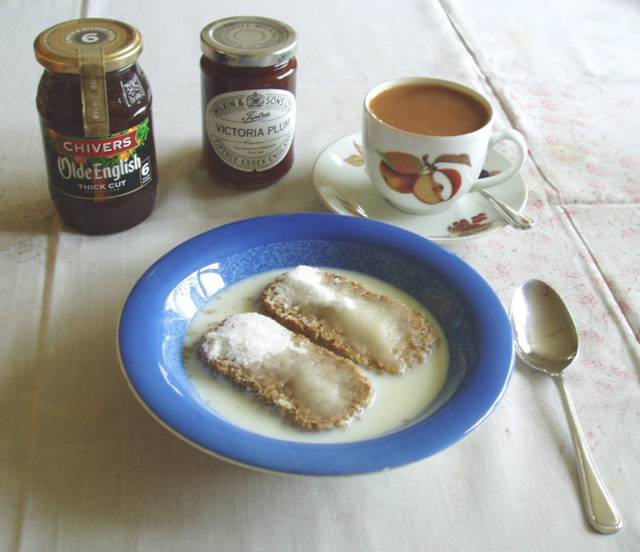
The much-favoured “soggy” consistency

Posted by Hello

More snow, and a very hard frost overnight. A result of this cold weather has been that early mornings, previously a bit gloomy, are now flooded with a strong bluish-white light (the dawn reflected off the snow).

Weekdays I get up at 6 and have breakfast at 6.45 – usually Weetabix and a cup of tea. If there is time (there often isn’t) I also have toast with marmalade and jam. The dining room faces south, and from this week I have been able to have breakfast by natural morning light, watching the birds in the garden and listening to the Today Programme on BBC Radio 4.

Weetabix is a breakfast cereal made in Northamptonshire. You put one or two Weetabix in a bowl, add sugar and cold milk, and wait half a minute while the cereal acquires the much-favoured “soggy” consistency. Recently I have cut down on the sugar.

Weetabix was founded in 1932 and was originally called The British and African Cereal Company.

Wednesday, February 23, 2005

Bread and circuses

Posted by Hello

As you can see from the picture, a real circus has come to town, and has opened up despite the snow.

Everyone expects a General Election to be held in May, and political campaigns have already been (unofficially) launched. The climate of electioneering is unmistakable – a sense of anticipation and expectation perpetually checked by cynicism and disillusion. Many commentators talk as if the election is a foregone issue, and that New Labour will sweep into power again, with their unique mixture of populism and watered-down socialism.

New Labour has been very adept at identifying groups of potential supporters (not always people who traditionally supported “old” Labour) and then bribing them with state patronage of various kinds (tax concessions, subsidies, housing developments etc). This is the way all political parties operate, but New Labour has been particularly skilful at isolating target audiences and winning them over with selling propositions. This makes me wonder what calibre of marketing professionals they have advising them, since their presentation is extremely slick (they certainly have PR professionals at every level of their operation).

Their achievement is all the more impressive when you consider the social fragmentation that has taken place in urban centres. While old allegiances to family, class and locality have broken down, New Labour has succeeded in building a new unity based on how people see themselves (“caring”, “modern”, “informal”). Supporting a political party has become a lifestyle choice, and New Labour is the first political party to have recognised this.

New Labour rule has been characterised by economic success and an emphasis upon euphoric prestige projects (the Millennium Dome, art centres such as Bankside and Baltic Mills, stadiums such as Wembley and Cardiff Millennium, the bid for the 2012 Olympic Games) which brings to mind the formula the patricians of ancient Rome used to keep the population quiet and compliant (Duas tantum rex anxius optat, panem et circensus – the people long eagerly for two things, bread and circuses. I had thought the quote came from Gibbon’s Decline and Fall but actually it was by the Roman poet Juvenal).

Booming neo-socialist economy, grand building projects, a culture in which everyone is encouraged to think of themselves as celebrities of some kind (no matter how marginal), a political use of language that is so pliant and manipulative that words and phrases mean whatever “they” want them to mean, a constitution that is routinely and arbitrarily chopped about to suit the requirement of the moment, a legal system that is abandoning trial by jury and introducing house arrest (and house arrest by political fiat!), an approach to international relations that has reintroduced war as a primary instrument of foreign policy…

The New Labour experience is for many (vulnerable) people, intoxicating, deliberately stressful, mildly fascist.

Tuesday, February 22, 2005

Enough to fill the furrows in the fields

Posted by Hello

There was snow over the weekend – not enough to settle, but enough to fill the furrows in the fields. Yesterday was bitterly, unreasonably, cold. Today is not quite so cold, and at the moment the sun is shining.

The farmer (who uses our sheds) likes freezing weather. He thinks it is healthy weather – it kills off vermin and bacteria.

Friday, February 18, 2005

The Spire

Posted by Hello

Spire being repaired by English Heritage.

I looked at this and immediately thought of William Golding’s novel The Spire. It’s about the triumph of hope over expediency as the Dean of a cathedral attempts to put an immense spire onto a tower that has no foundations. Even the stones sing (in his head) in honour of his endeavour.

Thursday, February 17, 2005

Fish and chips

Posted by Hello

Fish and chips were originally sold separately from small specialist shops. In the nineteenth-century shops selling both fish and chips started to appear (Charles Dickens mentions a fish and chip shop in Oliver Twist). It has now become a national dish and is even served in the restaurants of Sir Terence Conran.

I drive past several fish and chip shops on the way home. Sometimes, if I’m really hungry, I stop at the half-way point on the journey and buy some chips (and then have dinner when I get home). There are eight times more fish and chip shops in the United Kingdom than there are branches of McDonalds.

People’s eyes glaze over and they lose interest

There is currently an internal debate on which brand names the company should be using and which should be dropped. You can work out the value of a brand name by assessing the value of a company if it is sold (usually five times the annual profit) then deducting the value of any fixed assets (stock, buildings etc). The amount left over is the company’s “goodwill”, most of which represents the brand equity of the company.

The problem with this argument is that it is abstract, and I know from experience whenever I try to talk about abstract issues people’s eyes glaze over and they lose interest.

Wednesday, February 16, 2005

The evenings are beginning to draw out

Posted by Hello

The weather is bitterly cold at the moment, but at least the evenings are beginning to draw out a little. The sky is not completely dark when I leave work at 5.30 (actually closer to six o’clock most days as I like to work out what I am going to do the following morning and get things ready).

At the weekend, walking through a quiet street near a cathedral close, I took this photograph. It was about four o’clock in the afternoon – not dark, but most houses had electric lights on (usually without the curtains drawn, so that passers-by could see in). The colour of the sky can best be described as Prussian Blue.

Tuesday, February 15, 2005

A strategy that stems from her divorce

Marie-Astrid’s dinner party. She plans to hold six per year (I have the feeling that I’m going to be asked to all of them). It’s a strategy that stems from her divorce when I guess she lost most of her existing circle of friends and now has to build up new relationships (or, in my case, revive a friendship from her college years).

A long drive to the northern town where she lives. For once I was only a few minutes late, and also remembered where her house was (last time I had driven around for nearly an hour, trying to remember the name of the road). I got there at ten past eight, and parked in the drive – my car was the newest (and, in my opinion, smartest) one there.

The house, located in a quiet tree-lined road, was large and semi-detached. It was built in the 1970s, so was not very attractive (quite ugly really). Marie-Astrid got a generous settlement from her husband and decided to buy a modest house outright rather than go for something nicer that involved a mortgage. There was a large front garden, mostly lawn, with narrow borders of lavender around the edges. The front door was protected by a functional glass porch, doorbell not working so that I just opened the door and walked in.

All the other guests had arrived and Marie-Astrid introduced me – most of them I knew by sight from her birthday party. There were eight of us in all. I always feel a little uneasy meeting Marie-Astrid’s friends since they often seem to be better than me in some way (not richer or cleverer or even nicer, just better). My fellow guests at the dinner party were either regular church-goers (and not even Church of England, but a narrow American Baptist sect that seems very judgmental), or worked in the public sector (with that public sector aura of being morally superior to everyone else). All of them were vegetarians and non-drinkers.

The one person, I felt, who didn’t fit into this mould of moral rectitude was Marie-Astrid herself (I remember her at college when she had been very lively and daring and always the centre of attention).

Monday, February 14, 2005

A coat of arms for St Valentine's Day


In a cold church off a busy street, where I was photographing some 18th century monuments, I found a coat of arms for St Valentines Day. Gold chevron against a black ground, three crowned golden hearts, with a crowned golden heart as the crest. Why are the hearts crowned - are they saying Your love is king? Posted by Hello

In the window of WH Smith, a poster announcing popular love poems (How do I love thee, let me count the ways etc). Trashy magazines in the background. Posted by Hello

In the window of the British Heart Foundation charity shop people can leave their own personal love messages. Only older people seemed to want to stop and read what people had written (perhaps they are less cynical than the young). My former assistant, Adrian Taylor, had to do his community service in this very shop (he was convicted of affray after fighting in a nearby nightclub). Posted by Hello

St Valentines Day has become more commercialised in recent years. I blame the marketing profession for this - they twist everything into a sales proposition.  Posted by Hello

Not sure what these are. Even as pendants they seem impractical. One of the most idealised cinematic representations of St Valentines Day was in the Peter Weir 1975 film Picnic At Hanging Rock. Set in Australia in 1901 it is about a party of schoolgirls from a posh academy who go for a day trip to a renowned geological outcrop (some of them never come back). It must rank as one of the best films ever made in Australia. Posted by Hello

Friday, February 11, 2005

A single-minded obsession

There was a product meeting this morning. Neil Hancock (Sales Director) chaired the meeting, which was attended by Mike Slattery (Commercial Manager), Simon Lloyd (Purchasing Manager), Rob Hanlon (Purchasing Assistant), Craig Wymer (Northern Regional Sales Manager), Tony Boxall (who has moved into a technical role), and myself.

The room was cold, and the meeting went on for nearly three hours. Horrible coffee (from a machine in the warehouse) was brought in at 10.30 and 12. It was a practical meeting, and Neil Hancock was very effective in working through the agenda and cutting off any extraneous diversions. He works well with Craig Wymer, and the two of them (seated at either end of the board table) made all the decisions, the rest of us making occasional contributions (Simon Lloyd, who is new to the company, was painfully eager to make an impression, but there was no real opportunity for him to do this).

Neil Hancock is a cautious person who never takes a step unless he is sure of his footing. He has a comprehensive knowledge of the company’s products and this matches well with Craig Wymer’s comprehensive knowledge of the company’s customers, so that together they make a formidable team. They both have a single-minded obsession with achieving sales targets that borders on the fanatical.

I know it’s not very imaginative

Posted by Hello

Silver bullion coin showing Britannia (please ignore the tartan backdrop). I have three nieces and two nephews, and it is always a problem buying them presents (they have outgrown teddy bears). For the last three years I have been giving them gold and silver bullion coins – gold at Christmas, silver on their birthdays. I know it’s not very imaginative, but the date changes every year, and sometimes the designs change.

Thursday, February 10, 2005

Posted by Hello

Britannia, her spear tipped in gold, standing in the cool light of a February afternoon.

The Romans first created the idea of Britannia, thinking that the map of Britain looked like an armed woman sitting on a rock, with a lion at her feet. The Royal Mint uses an image of Britannia on silver bullion (St George appears on the gold bullion).

It looks as if Britannia, leaning against a ledge, is taking a break from guarding the nation and pointing to something going on in the street outside.

Wednesday, February 09, 2005

A storm in a teacup

There was an enquiry into yesterday’s mailshot incident, but it was the usual cover-up. Mike Slattery was mainly to blame for the fiasco, but he is always very clever at evading any direct responsibility – he does this by speaking extremely fast and repeating things endlessly. At the end of a conversation with him you have heard him say the same thing ten or fifteen times over, and you are so exhausted by this that you haven’t the energy to point out he has just spoken a load of garbage.

Marion Conway (Human Resources) also got involved, and it was obvious she just wanted to blame everybody for everything. The cheeky staff on the Sales Desk seem to have escaped without a rebuke of any kind.

In retrospect the whole thing seems like a storm in a teacup. At the end of the day, it’s not really a problem if the mailshot goes out a day late. It’s the lies and the cover-up that make it all stressful.

Anyway it is the start of Lent and for the next six weeks I have given up drinking alcohol, buying books (which is probably my biggest addiction) and staying up after 11 o’clock on a weekday (except for Tuesday 14th February, which I know will have to be a late night).

Tuesday, February 08, 2005

What am I supposed to do?

There is an important mailshot to be done. Two of the directors went to an exhibition in the middle east and came back with a heap of sales leads that need to be followed up. All the mailshot materials were assembled, and the mailshot had to go out as soon as possible (ie immediately).

Tracey, a part-time member of staff (fairly tall, slim, bubble perm, never wears make-up), is supposed to help with the mailshots. She is supposed to help on the Sales Desk in the first part of the morning, then come to Marketing to do any mailshots we might have. Except that recently she hasn’t been doing this (not a problem so far this year, as we havn’t been doing much in the way of mailshots).

Anyway, I double-checked with her boss Mike Slattery (who is supposed to manage the staff on the Sales Desk except that most of the time he just sits in his office) and made sure that it was OK for Tracey to do the mailshot. Yesterday I formally asked her to come over to Marketing as there was an important mailshot to go out (I shouldn’t have to do this, it is part of her job to do the mailshots).

I could tell when I asked her that she wasn’t keen on helping. I showed her how the packages should go out and she worked on it for an hour or so, until her day ended (she works until 2pm), then she just left everything.

This morning she was at her place on the Sales Desk, and when I asked her to come over and finish the mailshot she told me, in an off-hand way, that she was doing the filing. I told her that Mike Slattery had agreed that the mailshot should take priority. She made no answer (except for a knowing exchange of looks with the person sitting opposite her, which warned me that a trap had been planned).

I returned to the Marketing department, not sure what I should do next. Shortly afterwards, Kevin Maglio, supervisor on the Sales Desk (overweight, belligerent, always ready to pick a fight with anyone) bustled over to Marketing and told me that Tracey was not going to do the mailshot. I said it had been agreed with Mike Slattery. Kevin told me he had just spoken with Mike Slattery and he had said Tracey didn’t have to do it (obviously Mike Slattery doesn’t want to get involved and is just agreeing with whoever shouts loudest).

What am I supposed to do when staff refuse point blank to do their job? It’s Tracey’s job to help out with the mailshots in Marketing, and if she gets away with not doing this one, it is going to be impossible to get her to do anything in the future. I am faced with the choice of making a fuss and compelling Tracey to do the job she's paid to do, or doing the work myself (my preferred option), or (what everyone else seems to do) just let everything slide and don't bother whether the mailshot goes out or not.

Monday, February 07, 2005

Close to midnight

Posted by Hello

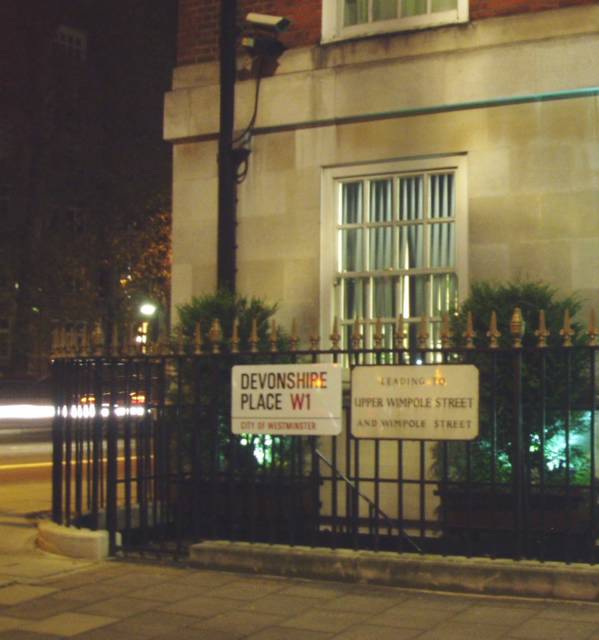
Marylebone, close to midnight. The air very cold. So much for my determination to be in bed by 11 o’clock each night.

Devonshire Place (leading to Wimpole Street). Notice the security camera attached to the lamp post. All of central London is watched by the police, in a real-life game of Big Brother.

Nothing much of interest in Devonshire Place apart from a very good (but very expensive) gym.

Wimpole Street is chiefly known because of The Barretts Of Wimpole Street, a 1934 film starring Charles Laughton and Maureen O’Sullivan (and the 1957 remake starring John Gielgud and Virginia McKenna). The film is a portrayal of the love affair between the poets Elizabeth Barrett and Robert Browning. Hardly anyone has read The Ring And The Book these days.

Number thirty-six Wimpole Street was the home of Sir Evelyn Baring, unofficial ruler of Egypt from 1883 to 1907. A blue plaque announces this fact. It was his son (also called Sir Evelyn Baring) who was Governor of Kenya in the 1950s, during the Mau Mau uprising. Autocratic, secretive and financially astute (he knew that modern warfare is fought financially as well as militarily) he crushed the rebellion with a ferocity that seems astonishing considering the liberal attitudes of the post-war era. He was able to get away with this because of his shrewd use of propaganda, and tight control of military expenditure (spending on counter-insurgency operations never grew to a level where it alarmed the Westminster government). He fought terror with terror.

Wednesday, February 02, 2005

Normally this is the sort of project I would enjoy

I have been working on the company newsletter over the last couple of days. It is intended to be a monthly publication, and is a full colour production. I have been surprised at how much enthusiasm there has been in the company for this new publication (previously we had an e-mail newsletter that was very rough and ready, and no-one took seriously).

Normally this is the sort of project I would enjoy, but Marion Conway (Human Resources Director) has become involved, and the project is becoming a nightmare. She has no idea of design or production, cannot edit copy, and all her suggestions and “improvements” are delivered in a screeching manic voice that at times seems only a short step away from hysteria.

It is very depressing to work with such a person. I know at least one person in the office who is keeping a diary of every time Marion Conway is rude to her, or behaves unreasonably (I suppose the diary is intended to be used as evidence at an Employment Tribunal – a sort of court which hears cases to do with violations of United Kingdom employment law).