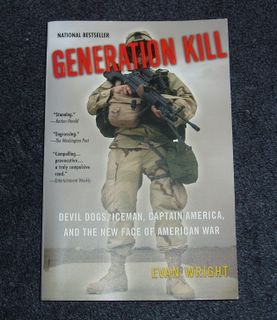
Recently I have been reading Generation Kill by Evan Wright. It is an account of the invasion of Iraq seen from the point of view of the frontline troops, as interpreted by journalist Evan Wright. I bought the book at the airport in New York, when I was returning from staying with Robert Leiper. It was an impulse purchase, and I mainly bought it because it said on the cover "...the new face of American war". I reasoned that the Iraq war was the most important on-going event in the world at the moment, and therefore I ought to take an interest in anything "new" about the conflict. The jacket claim proved to be a misleading statement however, as the work turned out to be a fairly conventional account of warfare.
What was remarkable about the book was the sense of immediacy of the writing. Evan Wright was an embedded journalist, and traveled with a United States Marine Corps platoon as it captured bridges, drove through urban ambushes, shot up Iraqi villages. Among the troops Evan Wright inveigles himself so that they at first ignore him, then tolerate him, and finally include him as a target for insults (indicating his acceptance).
Once on a level with the platoon he records their conversation with a Kiplingesque feel for the colloquial expressions of fighting men. He is careful to avoid satirising the platoon members, although one detects a certain level of irony in the way in which he reports verbatim the opinions of the private soldiers (are marines "soldiers"? or are they "marines"). They have many opinions about the way in which the war was conducted, the primitive conditions in which the Iraqi people live, the degeneracy of modern American society (how the war was intended to support the high living standards of the American middle classes, how it was a racist adventure waged by white people against non-whites, how Justin Timberlake represents the nadir of American morality).
Despite the excellence of the writing there was the impression that the book was a little contrived. Evan Wright never ever reveals his true thoughts. And there seemed to be a pre-conceived theme of lions led by donkeys (the officer referred to as "Captain America" was a one-dimensional figure - surely no-one could be that incompetent?). For a graduate in medieval history the author is curiously uncurious about the history and culture of the country through which he is passing. No parallels are made with previous historical episodes, so there is hardly any context. With more effort he could have written his own Seven Pillars of Wisdom.


No comments:
Post a Comment